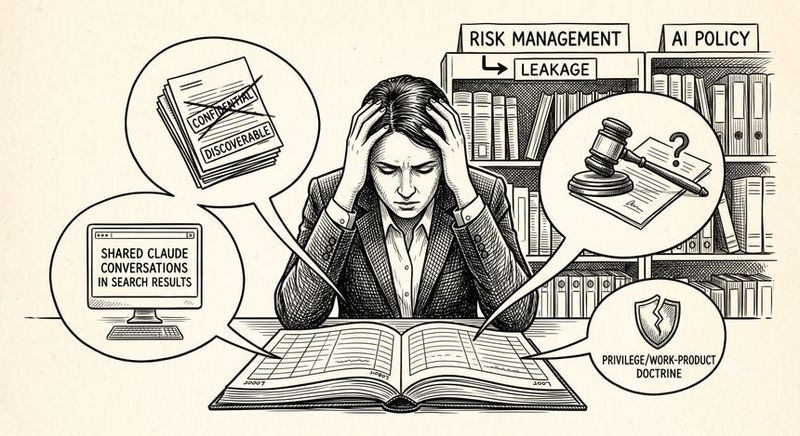

The Claude Transcript Problem: Not Necessarily Privileged, Sometimes Public
On July 25, 2026, a Reddit user reported that the search operator site:claude.ai/share returned strangers' conversations with Claude. Tech reporter Beatrice Nolan covered it for Fortune two days later, cataloguing work notes, names, addresses, and cryptocurrency wallet keys sitting in the index. WIRED's account has the detail that should stop any practitioner cold: among the exposed conversations was a lawyer asking whether attorneys in Kansas are required to self-report a suspected ethical violation. Separate reporting describes another lawyer's notes on a potential ethics complaint.
But nothing was hacked, and no account was breached. Every one of those conversations became public because a user pressed a button that generates a link anyone can open, and the link then landed somewhere a crawler could find it. Anthropic built the link to be public. Google indexed it because it was.
That is a privacy story, and most lawyers will file it there. It belongs in a second drawer as well, because a federal court has already told us what a consumer-tier AI transcript is worth when someone comes looking for it.
What Heppner held
The AI discovery dispute in United States v. Heppner, No. 1:25-cr-00503-JSR (S.D.N.Y.), reached Judge Jed Rakoff after federal agents seized 31 documents reflecting the defendant's exchanges with Claude. Defendant Bradley Heppner had retained counsel, ran his own legal research through the platform, and later gave what he learned to his lawyers. Counsel conceded they had not directed him to run those searches. Judge Rakoff ruled for the government from the bench on February 10, 2026, and issued a written memorandum one week later.
The court accepted the government's three arguments: (1) Claude is not an attorney, so an exchange between two non-attorneys about a legal problem is not a privileged communication. (2) The documents were not work product, because they were neither prepared by counsel nor prepared at counsel's direction. And (3) the defendant had no reasonable expectation of confidentiality, because the platform's privacy policy told him his communications could be used for secondary purposes including training and disclosure to third parties and government authorities.
The government's analogy was running a Google search or checking a book out of the library, neither of which becomes protected because the researcher later talks to a lawyer. Rakoff rejected the transfer theory outright:
"Indeed, it is black-letter law that non-privileged communications are not somehow alchemically changed into privileged ones upon being shared with counsel."
Why the two stories belong together
The third holding is the one with reach, because it has nothing to do with artificial intelligence. It turns on what the terms of service told the user, which is ordinary confidentiality analysis, and it applies to any tool whose policy reserves rights over what you type into it.
Heppner holds that a consumer-tier AI conversation was never confidential as against the government. The July incident is a different mechanism reaching the same records problem, because a transcript sitting in Google's index is not confidential as against anyone. Where the transcript was created sets the ceiling on the protection it can carry. What happens to it afterward can take away the rest.
What Formal Opinion 512 does not reach
ABA Formal Opinion 512, issued July 29, 2024, addresses generative AI across competence, confidentiality, informed consent, supervision, and fees. It speaks to what you put into these tools. But no ethics opinion, regulator guidance, or reported decision addresses whether affirmatively generating a public link to an AI conversation waives privilege or breaches Rule 1.6. That is an unfilled gap, and the inference runs against the lawyer: if merely typing into consumer Claude defeated the expectation of confidentiality in Heppner, publishing the transcript is difficult to characterize as a reasonable precaution.
The direction of travel is unfavorable, but the law is unsettled. Warner v. Gilbarco, Inc. (E.D. Mich. Feb. 10, 2026) denied a motion to compel a pro se plaintiff's ChatGPT materials, reaching the opposite result on overlapping facts because the plaintiff was her own advocate. Morgan v. V2X, Inc. (D. Colo. Mar. 30, 2026) cites both and amended the protective order to restrict uploading confidential discovery material to consumer AI tools. Using a third-party tool is not a categorical waiver. The standard remains whether the lawyer took reasonable precautions.
One more reason the transcript itself matters. In Fortis Advisors, LLC v. Krafton, Inc., C.A. No. 2025-0805-LWW (Del. Ch. Mar. 16, 2026), Vice Chancellor Lori Will recounted a buyer's CEO working through ChatGPT for a way out of a $250 million earnout and producing a "Response Strategy to a 'No-Deal' Scenario" the company then largely followed. The CEO admitted at trial that he had deleted some of the relevant logs. A chatbot turns an unformed intention into a sequenced plan, and opposing counsel will no doubt appreciate the organization.
The bottom line
- Treat consumer-tier AI transcripts as discoverable. Heppner got there on the privacy policy alone, without deciding anything peculiar to AI.
- Never generate a share link from a matter conversation. No authority blesses it, the reasoning available cuts against it, and the act is hard to square with reasonable precautions. Authenticated sharing inside an approved enterprise environment is a different question, answered by its access controls and contract terms.
- The personal account is the exposure. Enterprise protections do not follow a lawyer, an employee, or a client into a personal chatbot account. Claude Team and Enterprise plans cannot share publicly at all, so the risk sits entirely on the consumer tier. Part 2 takes up what administrators can and cannot actually control.
For questions about AI governance, privilege preservation, and confidentiality controls, please contact the Jones Walker Privacy, Data Strategy and Artificial Intelligence team. Stay tuned and subscribe for continued insights from the AI Law and Policy Navigator.