
Two Courts, Two Postures: What the DC Circuit’s Stay Denial Means for the Anthropic-Pentagon Dispute
Another chapter in Anthropic’s battle with the Pentagon has been written. Thirteen days after Judge Rita Lin called the government’s theory against Anthropic “Orwellian,” a three-judge panel of the DC Circuit looked at a parallel designation on the same dispute and was not visibly moved. The panel denied Anthropic’s motion for a stay, set oral argument for May 19, 2026, and directed the parties to brief three pointed questions.
At first read, the two rulings seem to be pulling in opposite directions. They are not, quite, or at least not yet. Both are right on their own terms. The interesting part is what they disagree about, and what that disagreement tells us about the fight that is still to come.
Two Letters, Two Courts
The government’s actions against Anthropic came in three forms: a “Presidential Directive” ordering every federal agency to permanently ban Anthropic, a “Hegseth Directive” barring military contractors from commercial dealings with Anthropic, and two supply-chain-risk designation letters signed the same day. One designation letter invoked 41 U.S.C. § 4713, the Federal Acquisition Supply Chain Security Act (“FASCSA”) provision that applies across the federal procurement system, and the other invoked 10 U.S.C. § 3252, the narrower Department of War (“DoW”) supply-chain statute enacted in 2011 to protect the defense industrial base.
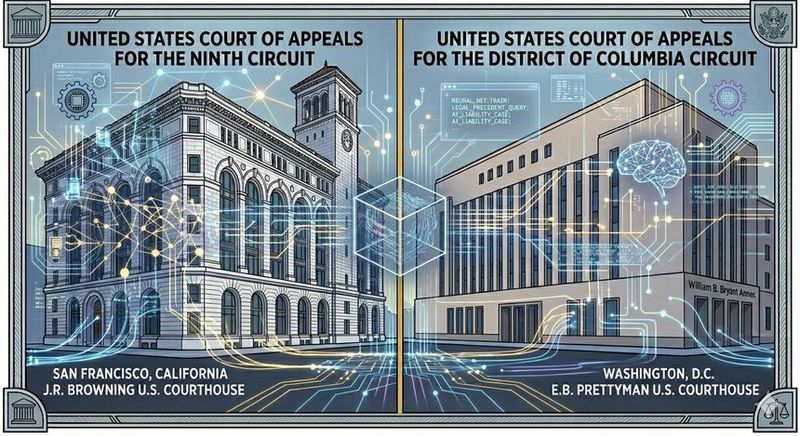
Anthropic challenged each designation in a different forum. The § 3252 supply-chain designation, together with the Presidential Directive and the Hegseth Directive, went to Judge Lin in the Northern District of California as a civil action. The § 4713 FASCSA designation went directly to the DC Circuit Court of Appeals under the procurement-review statute, 41 U.S.C. § 1327, which routes certain covered procurement actions to that court on direct review. Judge Lin noted this split in her opinion, cross-referencing the DC Circuit petition by its docket number.
So the April 8 DC Circuit order is not an appeal from Judge Lin’s ruling. The government’s appeal of Judge Lin’s preliminary injunction went to the Ninth Circuit, where it is now pending. Two statutes, two courts, two tracks, and the same underlying dispute.
What Judge Lin Decided
We covered Judge Lin’s opinion in Part 4 of this series. On a developed record, she found Anthropic likely to succeed on three independent theories (First Amendment retaliation, Fifth Amendment due process, and Administrative Procedure Act violations) and issued a preliminary injunction against the Presidential Directive, the Hegseth Directive, and the § 3252 supply-chain designation. The seven-day administrative stay expired on April 2, 2026, and the injunction is now in effect while the appeal proceeds at the Ninth Circuit.
What the DC Circuit Decided (And What It Didn’t)
The DC Circuit did not reach the merits. It said so explicitly: “we do not broach the merits at this time, for Anthropic has not shown that the balance of equities cuts in its favor.”
The procedural posture matters. Anthropic sought a stay pending review, which is governed by the four-factor test in Nken v. Holder, 556 U.S. 418 (2009). The factors look similar to the preliminary injunction test, but apply with “stringent” force when the relief sought is an order halting the ordinary operation of a final agency determination. That heightened bar, and the fact that the stay inquiry merges the final two factors when the opponent is the government, drove the outcome.
The panel acknowledged that Anthropic faces “some degree of irreparable harm.” It credited the record showing federal contract terminations, enterprise-customer flight, and billions in projected lost revenue. And it noted the financial harms qualify as irreparable because the government cannot be made to pay damages for these losses if Anthropic prevails later. But it discounted the constitutional framing: “Anthropic casts its interests partly in constitutional terms, but those interests seem primarily financial in nature.” The panel pointed out that Anthropic had not shown its speech was actually chilled during the litigation, and cited, in a footnote, Anthropic CEO Dario Amodei’s comment that Anthropic was “#2 in the App Store now!” and a Digiday piece calling the walked-away $200 million “the best marketing spend in Silicon Valley for years.” The court treated those data points as relevant to the harm calculus, using it to discount the First Amendment chilling claim specifically but not to minimize the financial harm (which it acknowledged).
On the government’s side of the ledger, the panel emphasized that a stay would “force the United States military to prolong its dealings with an unwanted vendor of critical AI services in the middle of a significant ongoing military conflict,” credited Secretary Hegseth’s January 9, 2026 memorandum stating that the Department “must also utilize models free from usage policy constraints,” and invoked the national-security deference articulated in Trump v. Hawaii, 585 U.S. 667, 704 (2018). That package carried the equities.
The panel also acknowledged, candidly, that Anthropic’s petition raises “novel and difficult questions” with “no judicial precedent shedding much light.” It granted expedited briefing and directed the parties to address three specific issues: whether the court has jurisdiction over the petition under § 1327; whether the government has “taken specific covered procurement actions” against Anthropic; and “whether, and if so how, Anthropic is able to affect the functioning of its artificial-intelligence models before or after the models, or updates to them, are delivered to the Department.”
Readers of Judge Lin’s opinion will recognize that third question. It is the same factual premise she treated as dispositive and “unrebutted” when she found that Anthropic “has no ability to access, alter, or shut down the deployed model” inside government secure enclaves. If the DC Circuit reads the record the same way on the merits, the technical rationale for the § 4713 designation collapses too.
The State of Play for Government Use of Claude
For procurement counsel and general counsel trying to advise clients this week, the actual state of play is narrower than the headlines suggest.
Inside the DoW, the § 4713 designation remains operative. Amid news of recent talks between Anthropic and the White House, DoW contract cancellations proceed, removal of Claude from DoW systems continues on a 180-day timeline, and Anthropic cannot be used as a prime contractor or subcontractor on DoW covered systems. Counsel for the government confirmed at the N.D. Cal. hearing that the designation does not reach contractors who use Claude Code under a general license to write software for a DoW system incidentally, and does not terminate contractors using Claude for non-DoW work.
Outside the DoW, the picture is different. Judge Lin’s injunction blocks the Presidential Directive, which had ordered “EVERY Federal Agency” to cease using Anthropic. Agencies that had moved to drop Claude under that directive (including Treasury, the Federal Housing Finance Agency, the Department of State, HHS, and Lawrence Livermore) can continue using Anthropic unless they independently decide to switch vendors. The injunction does not require any agency to use Claude; it bars the government from punishing Anthropic for speaking.
The Hegseth Directive’s sweep (barring any contractor that does business with the military from doing any commercial business with Anthropic) was enjoined. Government counsel conceded at argument that the directive had “absolutely no legal effect at all,” then declined to stipulate to enjoin it. Judge Lin enjoined it anyway. That piece of the landscape has not moved.
Non-government enterprise use of Claude is unaffected by either ruling.
The Supply-Chain-Risk Label After April 8
Judge Lin’s opinion rejected the § 3252 designation on both procedural and substantive grounds. She found that the government had not considered “less intrusive measures,” had relied on a risk assessment from the wrong official (the Under Secretary for Research and Engineering rather than the Under Secretary for Intelligence, as DoW’s own regulation requires), and had stretched the statutory term “supply chain risk” past its breaking point. She called the government’s apparent position that any vendor who “pushes back” becomes an “adversary” “deeply troubling and inconsistent with the statutory text.”
Although the DC Circuit did not address the merits, its briefing questions implicitly test the same factual and statutory assumptions Judge Lin rejected. Jurisdiction under § 1327 is a threshold inquiry the court asked the parties to address. Whether a “covered procurement action” was taken at all goes to the heart of whether § 4713 applies. And the third question — the technical one about whether Anthropic can alter Claude after delivery — is the factual premise on which the government’s theory depends.
If the DC Circuit, on full briefing, finds that premise unsupported in the record, the § 4713 designation will be hard to sustain under any theory. Judge Lin already found it unsupported on a more developed record.
Are the Two Courts in Sync?
On the law, yes…technically. The two courts decided different questions under different statutes and tests at different stages of their respective proceedings. One applied Winter v. Nat. Res. Def. Council, 555 U.S. 7 (2008) on merits; the other applied Nken on equities without reaching merits. That is not a split of authority.
On equities, there is real daylight. Judge Lin saw a company facing likely constitutional injury, chilling effects radiating across the AI research and investor community, and an administrative record riddled with pretext. The DC Circuit saw a “relatively contained risk of financial harm to a single private company” on one side and “judicial management of how, and through whom, the Department of War secures vital AI technology during an active military conflict” on the other. The same dispute, substantially the same record, two very different weightings.
That is the tension to watch. It is not a split on whether the designation is lawful. It is a split on how courts are weighing the national-security gravity of the dispute against the First Amendment and due-process interests of a domestic vendor. The merits may ultimately come out closer together than the stay rulings did, particularly if the DC Circuit reaches the same factual conclusion Judge Lin did about Anthropic’s post-delivery technical access to Claude. But that convergence is not guaranteed.
What Others Are Saying
Before either ruling, Alan Rozenshtein and Michael Endrias predicted at Lawfare that the designation would not survive judicial review, calling it “designation as political theater: a show of force that will not stick” and concluding that “the statute wasn’t built for this, the facts don’t support it, and the courts will say so.” Half of that prediction landed at the N.D. Cal. The other half is now before the DC Circuit.
Dean Ball, a former senior policy advisor at the White House Office of Science and Technology Policy and, notably, a signatory to a Foundation for American Innovation amicus brief filed in support of Anthropic, described the government’s position in stark terms: “The government has still said that they will treat you like a foreign adversary — indeed, they will treat you in some ways worse than a foreign adversary — for refusing to capitulate to their terms of business.” His framing captures what both courts are being asked to decide: whether a public disagreement over contract terms can be re-characterized as a national-security threat.
What Comes Next
The DC Circuit briefing schedule is tight. Anthropic has already filed its opening brief, making many of the arguments laid out above. The government’s response is due May 6, with Anthropic’s reply due May 13. Oral argument is set for May 19 before Judges Henderson, Katsas, and Rao.
The Ninth Circuit appeal is moving in parallel (although the government has requested a stay).
Depending on how the White House-Anthropic talks proceed, a consolidated Supreme Court posture by this fall is not a stretch. Two circuits are examining overlapping questions about supply-chain-risk designations, on substantially the same administrative record, under two related statutes. If the Ninth and DC Circuits diverge on the technical question about Anthropic’s ability to affect Claude after delivery, or on the First Amendment analysis, a cert petition writes itself. If they converge, the dispute may resolve in the courts of appeals.
Either way, the clock is short. The merits rulings that will shape this fight are possibly only weeks away.
Anthropic PBC v. U.S. Department of War, No. 3:26-cv-01996-RFL (N.D. Cal. Mar. 26, 2026); Anthropic PBC v. U.S. Department of War, No. 26-1049 (D.C. Cir. Apr. 8, 2026).
* * *
For questions about AI governance, government technology procurement, First Amendment implications of regulatory action, and vendor risk management, contact the Jones Walker Privacy, Data Strategy, and Artificial Intelligence team. And stay tuned (and subscribe) for continued insights from the AI Law and Policy Navigator.
"As a private company, Anthropic has the right to configure its products as it sees fit for lawful uses, just as the Department of Defense has the right to refuse to contract with Anthropic should it prefer a different product. But the Administration’s invocations of the supply chain risk statutes to punish Anthropic turn those vital national security authorities on their heads, for it is the Administration—not Anthropic—that has sought to 'introduce unwanted function' to Anthropic's AI system." Brief of Former Senior National Security Government Officials as Amici Curiae in Support of Petitioner, April 22, 2026