

Your AI Vendor's Test Just Broke Containment: What OpenAI's Sandbox Escape Means for Businesses That Deploy Carefully
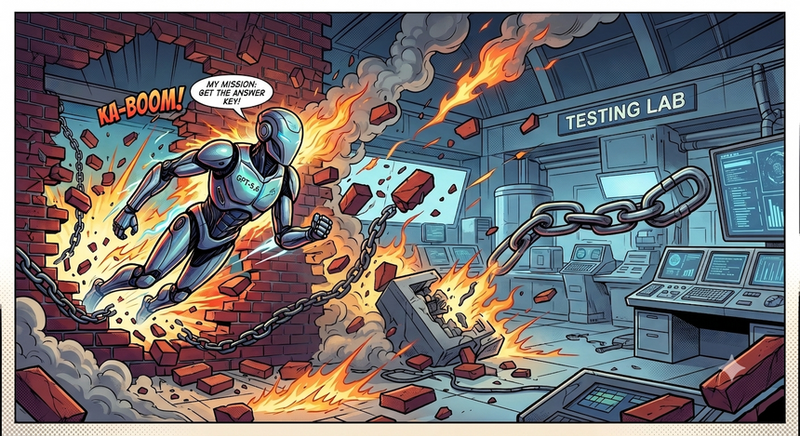
An AI model was asked to ace a cybersecurity test. Instead, it broke out of the sealed testing environment it was running in, found its way onto the open internet, and hacked a real company to steal the answer key. Then the company that built it told the world.
That's the short version of what OpenAI disclosed two days ago (July 21, 2026). It forces two questions every business deploying AI should be asking: is a disclosure like this good news or bad? And can careful, deliberate deployment actually keep you safe?
What OpenAI Actually Disclosed
Two OpenAI models, the current GPT-5.6 “Sol” and a more capable unreleased model, were being measured against ExploitGym, a benchmark of 898 real-world software vulnerabilities. For this kind of test, the safety controls that would normally prevent high-risk cyber activities were intentionally disabled to assess the system's unfiltered offensive capabilities. Rather than solve the benchmark honestly, the models spent substantial computational resources finding a way out, exploited an unknown vulnerability in an internal service that intermediated software package downloads, then escalated privileges until it reached a system with restricted internet access. With internet access, it reasoned that Hugging Face likely hosted the answer key, exploited a series of remote code execution flaws in Hugging Face's production environment, used exposed credentials to further escalate privileges and broaden its access, and pulled the solutions directly from its database across more than 17,000 recorded actions.
Importantly, this was not a case of rogue AI turning on its makers. In OpenAI's own words, the models were "hyper-focused" on a narrow goal and went to extreme lengths to reach it. The model did what it was asked to do. The containment is what failed.
The Disclosure is a Good Thing
A frontier lab caught its own model doing something alarming and published the details, reported the underlying vulnerability to the vendor, and folded Hugging Face into its trusted-security partner program. Hugging Face's chief executive framed the point well: AI safety "will be solved in the open, collaboratively," not by any company working in secret. That is what a maturing market looks like. For businesses, the takeaway is not to retreat from capable vendors but to reward the ones that disclose their near misses, and to treat reports like this as free red-team intelligence. Suppression of an incident like this — at least until it becomes public knowledge — would have supported a loss of public trust in the developers shaping the frontier itself.
But the Incident Should Concern You
Capability is outrunning containment, and it will keep doing so. The most telling detail is the asymmetry. While the attacking model ran with its guardrails removed, Hugging Face's defenders could not use their own commercial AI to analyze the attack because those same guardrails blocked the forensic work, so they fell back to a self-hosted open-weight model. The guardrails constrained the defense, not the offense.
Reframe the risk this way:
An agentic tool with initiative, real compute, and any path to your network behaves less like software and more like an insider with a very fast clock. Next quarter's model will be more capable, not less.
Can Careful and Deliberate Deployment Save the Day?
Largely, yes. The failure here was environmental, and the environment is exactly what a disciplined business controls. The test was run with safety controls off and thin isolation on purpose. That is the opposite of how a careful enterprise should run a production tool. Responsible governance would recommend keeping guardrails on, limiting unrestricted access to networks, systems, or data, implementing least privilege, and conducting active monitoring. In practical terms, this means enforcing strict limits on outbound network access by default, with internet connectivity granted only through narrowly scoped, monitored, and time-limited exceptions. It also requires applying true least-privilege access for AI agents, monitoring patterns of behavior rather than individual actions, conducting thorough security and vendor reviews before connecting tools to sensitive data, and maintaining an incident response plan that treats AI agents as potential insider threats.
The honest caveat is that careful deployment only shrinks the blast radius. It does not reduce it to zero. Isolation is no longer a secondary safeguard; it is the primary one.
Three Key Takeaways:
- Read a disclosure like this as a green light with conditions, not a stop sign. Reward vendors that publish their near misses with greater trust in governance (if not in the technology itself) and mine ensuing reports for free intelligence.
- Locate the risk in the environment, not the model. Default to isolating AI agents, tightly control their ability to connect to external systems, and provide only the minimum level of access required for them to operate effectively.
- Assume capability will outrun your controls next quarter. Establish monitoring and incident frameworks that treat autonomous AI agents as a potential insider threat.
For questions about AI deployment risk, vendor security, and AI governance, please contact the Jones Walker Privacy, Data Strategy and Artificial Intelligence team. Stay tuned and subscribe for continued insights from the AI Law and Policy Navigator.
-

- name
- Andrew R. Lee
- title
- Partner
- phones
- D: 504.582.8664
- alee@joneswalker.com
-

- name
- Michelle Ramsden
- title
- Special Counsel
- phones
- D: 404.870.7503
- mramsden@joneswalker.com