

Is There a Better Way to Regulate the Environment?
The chart below illustrates the growth of Title 40 of the Code of Federal Regulations — the section devoted entirely to EPA regulations. Since EPA’s creation by President Nixon on December 2, 1970, the volume of environmental regulations has expanded dramatically. By 2025, Title 40 contains nearly 32,000 pages, representing an average increase of about 592 pages per year since 1972.
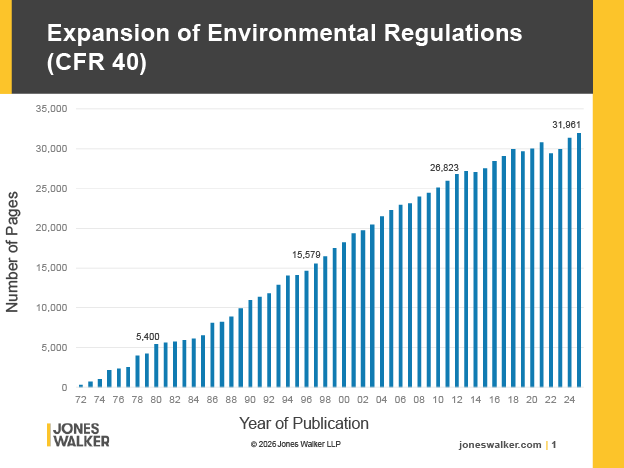
In an effort to slow this expansion, President Trump issued Executive Order 13771 in 2017, directing agencies to repeal two existing regulations for every new one. In 2025, he went further with Executive Order 14192, requiring the repeal of ten old regulations for every new regulation adopted. A quick look at the chart suggests these policies may be having an effect.
Yet even with efforts to streamline, the reality for the regulated community remains daunting. Environmental compliance today requires navigating tens of thousands of pages of EPA rules, additional federal and state regulations, underlying statutes, and the specific requirements of applicable permits. Understanding what is required is no small task.
For now, the most practical answer is that effective environmental compliance demands dedicated teams — professionals who can interpret, track, and manage the evolving regulatory landscape. Until a more efficient regulatory framework emerges, organizations must invest in the expertise needed to keep pace.

-

- name
- Robert "Bob" E. Holden
- title
- Partner
- phones
- D: 504.582.8139
- bholden@joneswalker.com
-

- name
- Meghan E. Smith
- title
- Partner
- phones
- D: 504.582.8709
- D: 713.437.1804
- msmith@joneswalker.com