

Nonmaritime Contracts Continue to Evolve - Fifth Circuit affirms Nonmaritime Contract Determination Involving a Liftboat
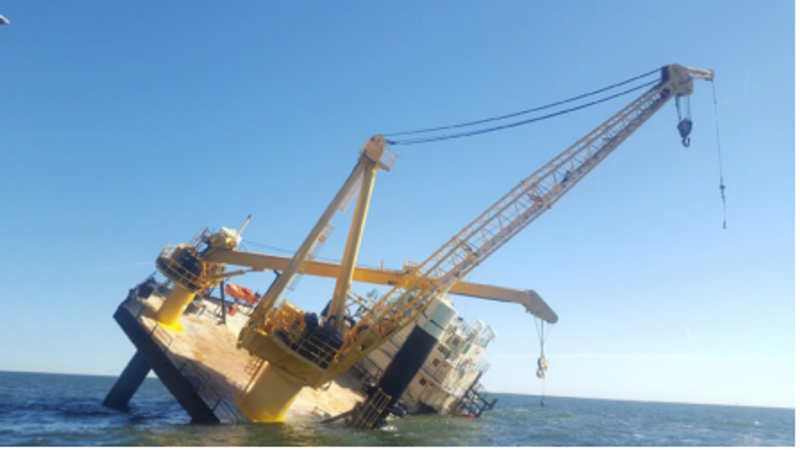
The categorization of maritime or nonmaritime contracts in the offshore energy space continues to generate litigation, and a recent Fifth Circuit decision continues the court’s trend of narrowly focusing this analysis on whether and how a vessel does (or does not) play a “substantial role” in contracted operations — even when a vessel plays some role in the underlying work.
In In re the Complaint of Aries Marine Corp., the Fifth Circuit affirmed that a master services contract governing work involving a liftboat adjacent to a fixed offshore platform but performed solely on the platform was nonmaritime, despite the obvious involvement of a jack‑up vessel.
The Incident
On November 18, 2018, the liftboat RAM XVIII (owned by Aries Marine Corp. and chartered to Fieldwood Energy) experienced a “punch through” incident offshore of Louisiana in the Gulf of Mexico (as it was then) in which one of its jack-up legs punctured the seabed, causing the vessel to list and partially sink. All crew members were ultimately rescued, with a few suffering various injuries during the incident. The RAM VXIII had been jacked up adjacent to a fixed offshore platform (owned by Fieldwood ) on the Outer Continental Shelf to provide “housing, meals, deck and office space, and construction and crane support” for contractors replacing the deck/grating on the fixed platform.
The Dispute
In the wake of the incident, Aries filed for limitation of liability pursuant to the Limitation of Liability Act (46 U.S.C. §30501 et seq.). An employee of United Fire and Safety, LLC (United), a Fieldwood contractor providing gas freeing and fire watch services, asserted personal injury claims in Aries' limitation action, and Aries in turn claimed a right to contractual defense, indemnity and additional insurance coverage (D&I/AI) from United pursuant to a 2013 Master Services Contract (MSC) previously entered between Fieldwood and United, pursuant to which Aries claimed a right to D&I/AI as a member of Fieldwood's “third party contractor group" as defined in the Fieldwood/United MSC.
The US District Court for the Eastern District of Louisiana granted United Fire's motion for summary judgment dismissing Aries' D&I/AI claims on the basis that the Fieldwood/United MSC was a nonmaritime contract under the Fifth Circuit's landmark en banc opinion In re Larry Doiron, Inc., 879 F.3d 568, 576 (5th Cir. 2018), and thus the Louisiana Anti-Indemnity Act (LOAIA, La. Rev. Stat. Ann. § 9:2780) applied as surrogate federal law under the OCS Lands Act (43 U.S.C. §1331 et seq.) to invalidate any contractual D&I/AI that Untied might otherwise have owed under the MSC.
The Fifth Circuit’s Analysis
Aries appealed and the Fifth Circuit affirmed in what might initially seem like a counterintuitive outcome - how can an agreement involving an indisputably “maritime” jack-up vessel not constitute a maritime contract? As the Fifth Circuit explained, however, this result was dictated under a straightforward application of the two-part Doiron test: (1) “is the contract one to provide services to facilitate the drilling or production of oil and gas on navigable waters?” and, if yes, (2) “does the contract [a] provide or [b] do the parties expect that a vessel will play a substantial role in the completion of the contract?”.
Focusing on the second question, the Fifth Circuit considered both the MSC and an emailed “Work to a Contractor” document that Fieldwood had submitted to United pursuant to the MSC for the specific gas freeing/fire watch work that was underway at the time of the incident. Under Doiron Question 2(a) (does the contract provide that a vessel will play a substantial role?), the Fifth Circuit found that “the only notable mention of a vessel in the MSC is for purposes of transportation,” but reaffirmed prior Fifth Circuit precedent confirming that “analysis of ‘substantial’ ignores the need for vessels to transport equipment and crew.” (citing In re Crescent Energy Servs., L.L.C., 896 F.3d 350, 360 (5th Cir. 2018)). Aries argued that United ”should have expected" that a vessel would play a substantial role in its work at the Fieldwood platform, but the Fifth Circuit rejected this argument under the precise terms of Doiron: “the Doiron rule does not require that United Fire “should have expected” a vessel to play a substantial role—we have to ask whether the parties do [emphasis in original] have that expectation.” Likewise, the “Work to a Contractor” email did not mention the RAM XVIII or any other vessel, and only addressed fire watch/gas freeing in “area[s] where welding work is to be performed" - i.e. the fixed platform only. There was also testimony from another contractor performing work on the platform that “nobody was aware they were getting on a lift boat.”
Turning to Doiron Question 2(b) (whether the parties expected a vessel to play a substantial role?), the Fifth Circuit began from its recent September 2025 opinion in Genesis Energy, L.P. v. Danos, L.L.C., 152 F.4th 648 (5th Cir. 2025), which addressed a similar scenario involving vessels supporting fixed offshore platform repairs and injury to a third-party contract employee while moving between a vessel and the platform. The Genesis court (as summarized by the Aries Court) held “the vessel was not a necessary work platform because the parties only anticipated that the vessel would house equipment that would be transferred to the platform, and ‘[t]hat role is insubstantial… [in addition to the fact that the vessel’s role for] transportation, housing the crew, and serving as a space for meals and safety meetings [was merely] ‘ancillary’ and ‘legally insufficient’” to warrant maritime contract status under Doiron. The Aries court went on to note that all Aries' arguments (relying on emails with Fieldwood) focused solely on what Fieldwood anticipated regarding use of a liftboat for the project, not what United itself anticipated vis-a-vis its MSC with Fieldwood. The court also rejected Aries' arguments that the RAM XVIII was essential because it supported crane operations, particularly in light of the fact that United's services did not require or involve crane work. Likewise, the Court rejected Aries' contention that because “fire watch” services could be maritime, they were necessarily so in every case, and were definitively not so here where United's actual work was performed entirely on the fixed platform.
Key Takeaway
The important takeaway from the Aries decision is that Doiron's Question 2(b) regarding contractual party expectations must be considered bilaterally as between the contracting parties only: “Our cases have made clear that a vessel’s substantial role must be a shared expectation,” and when both parties do not demonstrably share that expectation, their contract will be nonmaritime, even if there is ancillary vessel involvement.
The important takeaway from the Aries decision is that Doiron's Question 2(b) analysis regarding contractual party expectations must be considered bilaterally as between the contracting parties only: “Our cases have made clear that a vessel’s substantial role must be a shared expectation,” and when both parties do not demonstrably share that expectation, their contract will be nonmaritime, even if there is ancillary vessel involvement.
-

- name
- Christopher M. Hannan
- title
- Partner
- phones
- D: 504.582.8353
- channan@joneswalker.com