

Since commencement of the military operations in Iran in February of 2026, the issue of maritime shipping chokepoints has dominated headlines, with the focus on the Strait of Hormuz and Bab el-Mandeb Strait, linking the Persian Gulf and Red Sea (respectively) to the Indian Ocean and global shipping lanes more broadly. Even before this, the Federal Maritime Commission initiated a broad-based fact-finding proceeding entitled “Investigation Into Transit Constraints at International Maritime Chokepoints,” focusing on seven key straits/passages with an outsized effect on global oceangoing trade: the Northern Sea Passage, the English Channel, the Malacca Strait, the Singapore Strait, the Strait of Gibraltar, the Panama Canal, and the Suez Canal.
With the advent of an unprecedented and historic El Nino event in 2026, the issue of maritime bottlenecks is becoming a problem well beyond the Middle Eastern war theater due to effects on the water levels in Gatun Lake, the manmade body of water that controls the passage draft for vessels transiting the Panama Canal. Due to the extreme drought conditions brought on by this year's “Super El Nino” event, the water level in Gatun Lake has been trending well below historic levels, leading to increasing levels of passage restrictions by the Panama Canal Authority (PCA):
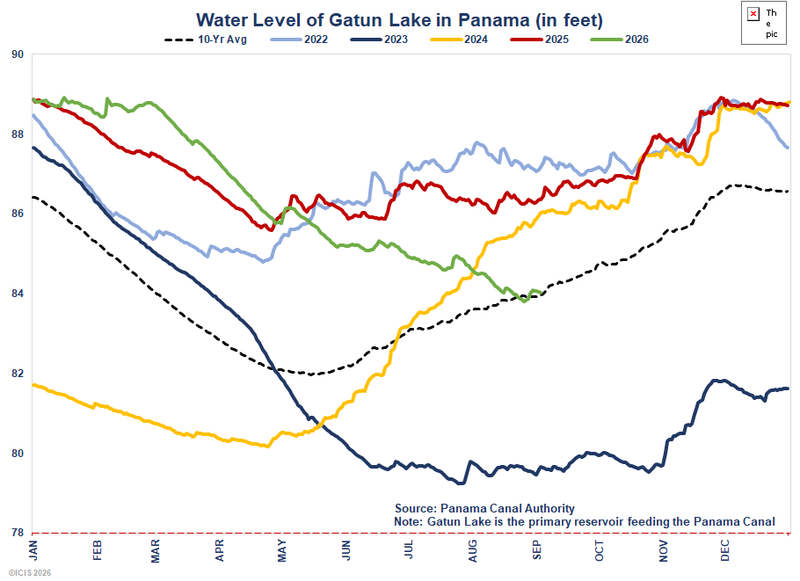
These conditions have led to both draft restrictions and per-day transit restrictions, the latter of which include a cap for daily vessel transits at 34 as of September 4, 2026, with a further reduction to 32 transits starting September 15, 2026. This, in turn, has led to PCA auctions for transit slots, resulting in a record-breaking $5.3 million bid (for a liquefied natural gas tanker) for transit on September 1, 2026, which “exceeded the previous record of $4.6 million set earlier in August and was nearly 100 times the median auction price of about $55,000 recorded before February.” Kathrin Wolf, Panama Canal transit auction reaches record $5.3 million (Aug. 28, 2026).
The unanticipated delays, and potentially unanticipated costs, of navigating the Panama Canal under present conditions can have serious implications for charter party (C/P) terms, particularly with regard to redelivery and termination terms. Generally speaking, a C/P redelivery deadline will be deemed to be an approximate one absent specific, express wording stating otherwise: “Where a time charter is for a stated period, the date for re-delivery should be regarded as an approximate date only, unless there is a clear agreement to the contrary.” THE ALMA SHIPPING CORPORATION OF MONROVIA v. MANTOVANI (THE "DIONE") COURT OF APPEALT, SMA No. 860A (1974). In either case (i.e. whether the redelivery date is approximate or a date certain under sufficiently express C/P language), the final voyage of the vessel to the redelivery port generally must adhere to the so-called “legitimate final voyage” doctrine. This rule requires that a time charterer's “final” voyage instruction on the redelivery voyage must be issued in circumstances that would reasonably allow — based on all known or reasonably knowable facts at the time the order is issued and/or when the final voyage is ready to commence — for the vessel to be timely redelivered to the redelivery port. “As a general rule, a shipowner is not obliged to obey a charterer's order to perform an illegitimate last voyage, defined as a voyage that cannot be completed in time for the vessel to be redelivered within the contract period.” In Re Addison Shipping & Trading SA, as Owner of M/V SEA WORLD - and- Bayoil Supply and Trading Limited, as Charterer, and Bayoil U.S.A. Ltd. as Guarantor, under a Time Charter dated July 13, 2000., SMA No. 3791 (2003). Whether and how the doctrine applies — and in particular the point (or points) in time at which the reasonableness of timely redelivery should be assessed — are highly fact and circumstance dependent and will also depend on the wording of the relevant C/P clauses.
Due to the Panama Canal transit and draft restrictions currently in place and anticipated through the fall, the “legitimate final voyage” doctrine should be a front and center consideration for both vessel owners and time charterers for vessels whose trade patterns require canal transits as part of any redelivery voyage. If a vessel's redelivery voyage commences on the Pacific side of the Panam Canal bound for a Caribbean/Atlantic-side redelivery port (or vice versa), careful consideration must be given by both the charterer and the owner as to whether there is a reasonable basis for that voyage to be completed within the redelivery period. In this regard, “[t]he relevant time for considering the question of reasonableness of an estimate as to the length of the last voyage is [generally] immediately prior to the last voyage" (Wilford, Coghlin and Kimball, TIME CHARTERS, p. 90 (3rd ed. 1989)); although some authorities direct that what might be an initially legitimate final order may be rendered illegitimate by a change in circumstances after issuance and before commencement of that voyage. This inquiry is necessarily fact intensive and fact-specific, and will also depend largely on the terms of the C/P itself.
Given the highly circumstantial factors informing the doctrine, numerous questions may arise if a vessel finds itself held up and waiting in line until the next round of capped canal transits. Does the “legitimate final voyage” doctrine require that a charterer or owner participate in an PCA auction to ensure timely redelivery in a trans-canal redelivery voyage? If so, who will bear responsibility for the auction price under the C/P terms? If not, who is responsible, and at what rate, for any alternative routing around the Panama Canal, including potentially via the much longer (and sometimes more perilous) routes through Straits of Magellan or Drake Passage around South America? How do “utmost despatch” and “deviation” clauses (and potentially other similarly directed clauses) affect the situation? Likewise, how do any delays (whether waiting for canal passage or re-routing) affect cost allocations under the C/P terms for things such as bunkers, pilotage, and other operating expenses? With respect to PCA draft restrictions, who will bear responsibility for any cargo carriage restrictions/limitations resulting from reduced capacities to comply with those restrictions? These are all potential questions that should be front of mind for vessel owners and charterers as the Panama Canal continues to experience these historic environmental impacts of the “Super El Nino.”
-

- name
- Christopher M. Hannan
- title
- Partner
- phones
- D: 504.582.8353
- channan@joneswalker.com