

When ChatGPT Meets the Legal Hold: A Survival Guide for the In-House Counsel Who Didn't Sign Up for This
You are your company's in-house legal counsel. It's 3 PM on a Friday (because of course it is), and you've just received notice of impending litigation. Your first thought? "Time to issue a legal hold." Your second thought, as you watch your colleague casually chatting with Claude about contract drafting? "Oh no... what about all the AI stuff?"
Welcome to 2025, where your legal hold obligations just got an AI-powered upgrade you never signed up for. This isn’t just theoretical hand-wringing. Companies are already being held accountable for incomplete AI-related preservation, and the costs are real — both in terms of litigation exposure and the scramble to retrofit compliance systems that never anticipated chatbots.
The Plot Twist Nobody Saw Coming
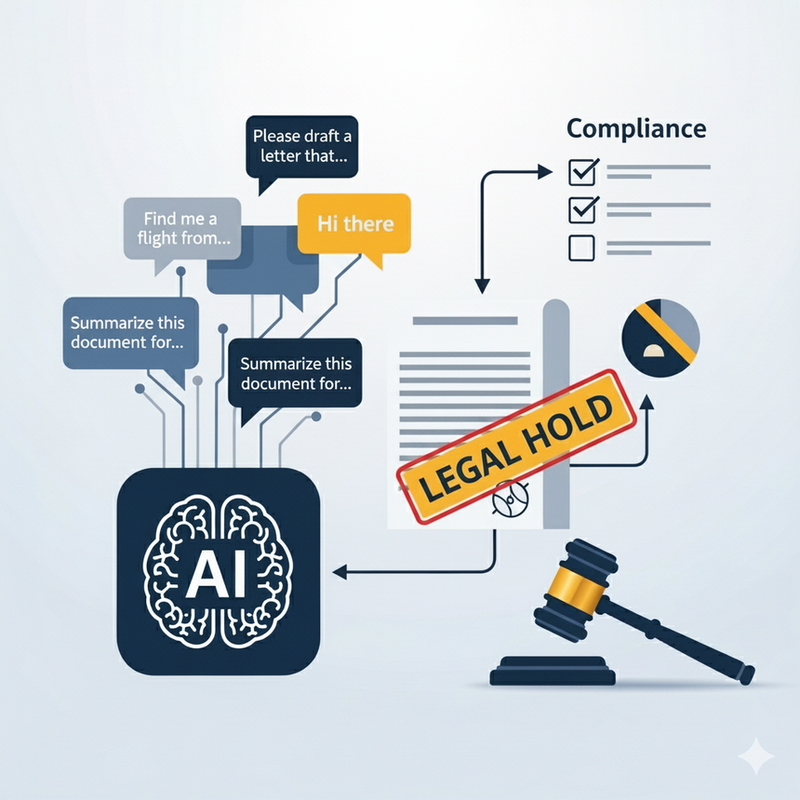
Remember when legal holds meant telling people not to delete their emails? The foundational duty to preserve electronically stored information (ESI) when litigation is “reasonably anticipated” remains the cornerstone of legal hold obligations. However, generative AI's emergence has significantly complicated this well-established framework. Courts are increasingly making clear that AI-generated content, including prompts and outputs, constitutes ESI subject to traditional preservation obligations.
Those were simpler times. Now, every prompt your team types into ChatGPT, every AI-generated marketing copy, and yes, even that time someone asks Perplexity for restaurant recommendations during a business trip — it's all potentially discoverable ESI.
Or so say several recent court decisions:
- In the In re OpenAI, Inc. Copyright Infringement Litigation MDL (SDNY), Magistrate Judge Ona T. Wang ordered OpenAI to preserve and segregate all output log data that would otherwise be deleted (whether deletion would occur by user choice or to satisfy privacy laws). Judge Sidney H. Stein later denied OpenAI’s objection and left the order standing (now on appeal to the Second Circuit). This is the clearest signal yet that courts will prioritize litigation preservation over default deletion settings.
- In Tremblay v. OpenAI (N.D. Cal.), the district court issued a sweeping order requiring OpenAI “to preserve and segregate all output log data that would otherwise be deleted on a going forward basis.” The Tremblay court dropped a truth bomb on us: AI inputs — prompts — can be discoverable.
- And although not AI-specific, recent chat-spoliation rulings (e.g., Google’s chat auto-delete practices) show that judges expect parties to suspend auto-delete once litigation is reasonably anticipated. These cases serve as analogs for AI chat tools.
Your New Reality Check: What Actually Needs Preserving?
Let's break down what's now on your preservation radar:
The Obvious Stuff:
- Every prompt typed into AI tools (yes, even the embarrassing ones)
- All AI-generated outputs used for business purposes
- The metadata showing who, what, when, and which AI model
The Not-So-Obvious Stuff:
- Failed queries and abandoned outputs (they still count!)
- Conversations in AI-powered Slack bots and Teams integrations
- That "quick question" someone asked Claude about a competitor
The "Are You Kidding Me?" Stuff:
- Deleted conversations (spoiler alert: they're often not really deleted)
- Personal AI accounts used for work purposes
- AI-assisted research that never made it into final documents
Of course, knowing what to preserve is only half the battle. The real challenge? Actually implementing AI-aware legal holds when your IT department is still figuring out how to monitor these tools, your employees are using personal accounts for work-related AI, and new AI integrations appear in your tech stack on a weekly basis.
Next week, we’ll dive into the practical playbook for AI preservation — including the compliance frameworks that actually work, the vendor questions you should be asking, and why your current legal hold software might be more helpful than you think (or more useless than you fear).
P.S. - Yes, this blog post was ideated, outlined, and brooded over with the assistance of AI. Yes, we preserved the prompts. Yes, we're practicing what we preach. No, we're not perfect at it yet either.
-

- name
- Andrew R. Lee
- title
- Partner
- phones
- D: 504.582.8664
- alee@joneswalker.com